- Get link
- X
- Other Apps
Irga - planting, selection of seedlings and growing

Berries irgi or geese are a pantry of flavonoids, which strengthen human immunity, and prevent the development of cancer.
In Irge contains a lot of pectin - an organic compound that removes toxins and heavy metals from the intestine, improves the functioning of the cardiovascular system. We wrote about him in detail earlier . Pectin makes berries irgi suitable for the preparation of jelly-like products: confiture, jam and jelly.
Biology of Culture
The Motherland of Irgi - North America. The plant was imported to Europe from the 16th to 19th centuries. After acclimatization, several new species appeared. One of them, the hornfish, became popular.
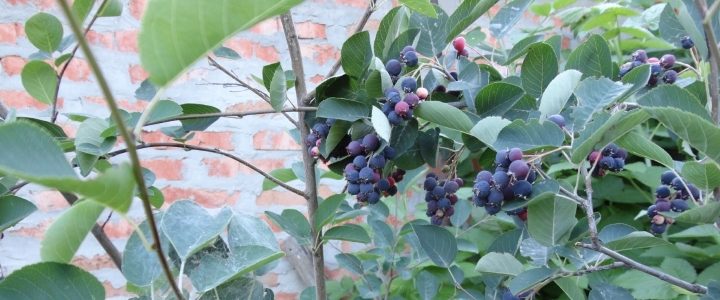
Painted in dark blue with a blue bloom, the berries of the horseradish are delicious and useful. The plant can be found in suburban areas, in the forest, in the copses - it is unpretentious and grows everywhere, giving a consistently high yield. Irgi flowers carry spring frosts to -7 degrees. The main fruiting is focused on the growth of the last year.
Plants are suitable for high hedges. The bushes themselves will grow and thicken, giving an abundant root shoot. With proper care the bush of irgi lives in the garden until the age of 70.
How to choose syringe seedlings
Selective work with the gnat was started in Canada 60 years ago. In the same place, the first varieties were formed. Sortovaja igra below wild-growing. Its fruits are almost twice as large and ripen in the brush at the same time.
From Canadian varieties in Russia are known:
- Smauk,
- Thyson,
- Ballerina,
- Princess Diana,
- Forest Prince.
In Russia there is almost no selection work with the Irga. In the state register there is only one variety - Starry Night. He has an average maturity period. The weight of the berry is 1.2 g, the shape is oval, the color is violet-blue. The fruits contain 12% of sugar, the taste is good with a delicate aroma.
Saplings of Irgi can be with an open and closed root system. If the roots are open, you need to examine them. Choose those that have a lot of small roots. It is better if they are treated with a clay chatterbox. On the seedlings, the place of grafting should be clearly visible, the kidneys should be asleep, and the leaves should be furred.
Seedlings with a closed root system are one to two years old. An annual plant is better than a two-year-old plant, as it quickly heals.
Preparing for the planting
Irgu is planted as close as possible to the garden house, so that the birds will less peck the berries.
Soil preparation:
- The territory in the spring is released from weeds and kept until fall under black steam.
- If the site is initially clean, in summer it is planted legumes - they improve the soil, make it more structural, saturated with nitrogen.
- On clay soil, you must make humus - up to 8 kg per square meter. m, and river sand - up to 20 kg per square meter. m.
Landing of Irgi
Culture loves light. In the shade, shoots are stretched, yield decreases. In irradiated places, the irga gives a higher yield, and the fruits are made more sweet.
The best time to plant a bird is autumn. Bushes planted so that for each accounted for 3-4 square. m. In the nurseries use the scheme of planting 4x2 m and 4x3 m. Large planting irgi planted at a distance of 1.2 m in a row in the trench.
To plant a single bush in the country, it is enough to make a pit with a diameter of 70 cm and a depth of 50 cm.
The pit is excavated without mixing the upper layer, rich in humus, with the lower one:
- Put the first portion of soil aside.
- At the bottom, pour 400 g of superphosphate, kilogram of ash or 200 g of potassium sulfate.
- Tuki mix with the ground at the bottom of the pit and make an eminence.
- Plant the plant on the mound so that the rootlets are evenly distributed in all directions, and fill them with humus earth.
- During the filling of the soil, the seedling is slightly shaken - this will help the soil to stick to the roots better.
After planting, the seedling should stand strictly upright, and the root neck should be at the soil level or slightly higher.
A seedling with an open root system is planted in the same way, but the mound does not need to be done. The plant is removed from the container with a clod of earth and set to the bottom of the pit. It should be ensured that after filling the root neck is not buried.
Care for Irga
Corinka is not demanding on soils, it can grow even on stony soils, it tolerates frosts to -50, drought-resistant. The tree is fast-growing, fruiting annually and growing rapidly. Irga easily tolerates a haircut, releasing 15-20 new growth shoots every year, can also grow due to rhizome offspring.
Watering
In the southern zone the Irga have to water. Additional moisture makes the berries larger and juicy. In a temperate climate, the plant is naturally hydrated. If there is a desire to water the Irgu, it should not be sprinkled, but under the root, pouring 30-40 liters of water under the bush from the hose.
Additional fertilizing
The plant possesses powerful, diverging in depth and in the sides roots, therefore does not need frequent top dressing. On poor soils consisting of sand, in the spring they make humus, spreading one or two organic buckets in the trunk of each bush.
Do not dig up the soil, so as not to damage the roots. Organics with irrigation and rainwater itself will penetrate to the roots. Will contribute to this and earthworms. While the humus will be on the surface, it protects the near-trunk circle from the weeds, and then becomes a fertilizing.
In the middle of the summer, before the fruiting, it is useful to feed the corn with a liquid composed of ammonium nitrate (50 g / bush) or the bird droppings in the water. Fertilizer is poured out in the evening after heavy rain or watering.
Trimming
The main care for the gum is pruning. The bush is quickly darkened at the base, and the crop leaves on the periphery of the crown, in an uncomfortable area for collection. To prevent this from happening, cut out the old shoots, lightening the tree and trying to remove everything that thickens it. Corine is not afraid of pruning, so you can cut branches easily.
Pruning starts from 3-4 years of age. Branches are sheared in early spring. At the same time, the entire root shoot should be cut out, leaving 1-2 shoots, grown almost from the base of the bush.
In 8-10 years, rejuvenating pruning is carried out. It can be done earlier if the annual growth has decreased to 10 cm.
Anti-aging measures:
- Remove all weak, thin, excessively long branches - no more than 10-15 shoots should remain on the bush;
- Shorten the highest shoots to a height of 2 m;
- Lubricate the circumcised areas with var.
Irg Grafting
The Corinette can be used as a reliable, hardy, frost-resistant rootstock for dwarf pears and apple trees. The vaccine is made by the method of "improved copulation" for two-year-old seedlings of the horny logs.
For the varietal root of the root can become a red mountain ash. On her stem, in the spring, the kidney is planted with irgi. Eyes survival rate up to 90%.
Reproduction of Irgi
Breeding Irgu, growing on the fringes and in forest belts, breed birds. Drozdy eats berries, but in their stomachs only the flesh is digested, and seeds with droppings fall into the soil.
In horticulture, you can also use the seed reproduction of irgi. Seedlings of the gorilla are very homogeneous and similar to each other as clones. This is due to the fact that the culture is able to reproduce asexually, but this process is almost not studied.
Seed of Irgi is similar to a crescent of 3.5 mm long, brown in color. The gram contains 170 pieces.
Seeds are isolated from fully ripened berries:
- Collect the berries from the bushes in September-October.
- Open the pestle.
- Rinse in water, separating the mash.
- Remove unripened seeds that have floated upward.
- Repeat the procedure two or three more times, until the water is left only the seeds on the bottom of the container.
The Irgas are sown in the fall so that they pass through the soil in a natural stratification. Seeds are sealed to a depth of 0.5-1.5 centimeters. In the spring there will be amicable shoots, which can be placed on a permanent place.
One meter of seed is sown on a linear meter. Before planting, the garden is fertilized with superphosphate - a tablespoon per sq. M. m or tea on the runway. m. grooves. The distance between the grooves is 18-20 cm. Seedlings dive when 3-5 true leaves are formed.
The second way of reproduction is by root offspring. They can be separated from the tree early in the spring and transplanted to a new location. After planting, the stem of the seedling should be cut to half, in which case it will settle down faster.
Green cuttings
In the summer, shoots of 12-15 cm long with a green stem are cut and cuttings with 4 leaves cut from them. The two lower plates are removed.
Cuttings are planted in a mini-greenhouse. The substrate is made up of a layer of pebbles covered with a mixture of light soil and humus. A layer of sand 4-5 cm is topped up on top. The cuttings are planted obliquely, they are watered and the lid is covered with a hothouse.
The roots will appear in a month. For the process to succeed, the humidity should be 90-95%. When processing cuttings with rootstock, the survival rate increases by 30%.
The entrenched branches should be left in the greenhouse until next year. In the spring they can be planted on a bed. Saplings, obtained from cuttings of irgi, develop rapidly, and already in autumn they can be planted in a permanent place.
Comments
Post a Comment